
 login/create account
Circular choosability of planar graphs ★
Author(s): Mohar
Let  be a graph. If
  and
and  are two integers, a
  -colouring of
  is a function
  from
from  to
to  such that
  for each edge
  . Given a list assignment
  of , i.e.~a mapping that assigns to every vertex
  a set of non-negative integers, an -colouring of is a mapping
  such that
  for every
  . A list assignment is a
  --list-assignment if
  and
and  for each vertex
  . Given such a list assignment , the graph G is --colourable if there exists a --colouring , i.e. is both a -colouring and an -colouring. For any real number
  , the graph is --choosable if it is --colourable for every --list-assignment . Last, is circularly -choosable if it is --choosable for any , . The circular choosability (or circular list chromatic number or circular choice number) of G is
Problem What is the best upper bound on circular choosability for planar graphs?
Keywords: choosability; circular colouring; planar graphs
A conjecture about direct product of funcoids ★★
Author(s): Porton
Conjecture Let  and
and  are monovalued, entirely defined funcoids with
  . Then there exists a pointfree funcoid
  such that (for every filter
  on
on  )
)  (The join operation is taken on the lattice of filters with reversed order.)
and are monovalued, entirely defined funcoids with . Then there exists a pointfree funcoid such that (for every filter on ) (The join operation is taken on the lattice of filters with reversed order.) A positive solution of this problem may open a way to prove that some funcoids-related categories are cartesian closed.
Keywords: category theory; general topology
Special M ★★
Author(s): Kimberling
Let  denote the golden ratio,
  and let
  denote the floor function. For fixed
  , let
, let  , let
, let  , and let
 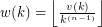 . We can expect
  to have about the same growth rate as
  .
.
Conjecture Prove or disprove that for every fixed  , as
, as  ranges through all the positive integers, there is a number
  such that
  takes each of the values
  infinitely many times, and
  . (Can you formulate as a function of ? Generalize for other numbers ?)
, as ranges through all the positive integers, there is a number such that takes each of the values infinitely many times, and . (Can you formulate as a function of ? Generalize for other numbers ?) Keywords:
 Drupal
 CSI of Charles University