
 login/create account
Do filters complementive to a given filter form a complete lattice? ★★
Author(s): Porton
Let  is a set. A filter (on )
  is by definition a non-empty set of subsets of such that
  . Note that unlike some other authors I do not require
  . I will denote
  the lattice of all filters (on ) ordered by set inclusion.
Let  is some (fixed) filter. Let
  . Obviously
  is a bounded lattice.
I will call complementive such filters  that:
that:
 ;
;- is a complemented element of the lattice .
Conjecture The set of complementive filters ordered by inclusion is a complete lattice.
Keywords: complete lattice; filter
Distribution and upper bound of mimic numbers ★★
Author(s): Bhattacharyya
Problem
Let the notation  denote ''
 divides
  ''. The mimic function in number theory is defined as follows [1].
Definition For any positive integer  divisible by
  , the mimic function,
  , is given by,
divisible by , the mimic function, , is given by,
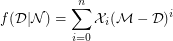
By using this definition of mimic function, the mimic number of any non-prime integer is defined as follows [1].
Definition The number  is defined to be the mimic number of any positive integer , with respect to , for the minimum value of which
  .
.
is defined to be the mimic number of any positive integer , with respect to , for the minimum value of which . Given these two definitions and a positive integer , find the distribution of mimic numbers of those numbers divisible by .
Again, find whether there is an upper bound of mimic numbers for a set of numbers divisible by any fixed positive integer .
Keywords: Divisibility; mimic function; mimic number
 Drupal
 CSI of Charles University